ТРАНСФОРМАЦИЯ БИЗНЕС-МОДЕЛЕЙ ПРЕДПРИЯТИЙ В УСЛОВИЯХ ПЕРЕХОДА К ЦИРКУЛЯРНОЙ ЭКОНОМИКЕ
Казанский (Приволжский) федеральный университет
бакалавр
Аннотация
Рассматриваются изменения ценностного предложения, операционных процессов и структуры доходов предприятий при переходе к циркулярной экономике. Анализ основан на современных научных публикациях, статистике Евростата и материалах Международной организации труда. Сопоставлены продление жизненного цикла продукции, сервисные модели доступа и возврат материалов в производство с точки зрения ресурсных потоков, извлечения экономической выгоды и ограничений внедрения. Установлено, что трансформация не сводится к переработке отходов, поскольку предполагает развитие обратной логистики, изменение взаимодействия с потребителями и координацию цепей поставок. Показана неоднородность институциональных и организационных условий перехода. Предложены финансовые, операционные, экологические и кадровые показатели для оценки жизнеспособности циркулярных бизнес-моделей. Выводы основаны на анализе вторичных данных и не предполагают универсального преимущества отдельной модели.
Ключевые слова: извлечение экономической выгоды, малые и средние предприятия, обратная логистика, продуктово-сервисные системы, ресурсоэффективность, трансформация бизнес-моделей, циркулярная экономика
TRANSFORMATION OF BUSINESS MODELS OF ENTERPRISES DURING THE TRANSITION TO A CIRCULAR ECONOMY
Kazan (Volga region) Federal University
Bachelor’s Degree
Abstract
The article examines how the transition to a circular economy changes the value proposition, operating processes and revenue structures of enterprises. The analysis draws on recent scientific publications and data from Eurostat and the International Labour Organization. Product life extension, service-based access and material recovery are compared in terms of resource flows, value capture and implementation constraints. The results indicate that circular transformation extends beyond recycling: it requires reverse logistics, new customer relationships and coordination across supply chains. Evidence on material use and employment also reveals substantial differences in the institutional and organizational conditions of this transition. A set of financial, operational, environmental and workforce indicators is proposed for assessing the viability of circular business models. The conclusions are based on secondary evidence and do not imply that any single model is universally superior.
Keywords: business model transformation, circular economy, product-service systems, resource efficiency, reverse logistics, small and medium-sized enterprises, value capture
Рубрика: 08.00.00 ЭКОНОМИЧЕСКИЕ НАУКИ
Библиографическая ссылка на статью:
Колесникова Е.А. Трансформация бизнес-моделей предприятий в условиях перехода к циркулярной экономике // Современные научные исследования и инновации. 2026. № 11 [Электронный ресурс]. URL: https://web.snauka.ru/issues/2026/11/105294 (дата обращения: 10.11.2026).
Introduction
Pressure on primary resources has increased the economic significance of product durability, material recovery and more efficient use of assets. In 2024, secondary materials accounted for 12.2% of total material use in the European Union (EU), reflecting only a modest increase from the preceding year [1]. The gap between resource efficiency objectives and observable material flows makes the enterprise business model an important unit of analysis. A change in production technology does not necessarily alter the means by which a company earns revenue. Circular operations may require product redesign, ownership arrangements, collection networks and contractual incentives that are absent from linear business models. Recent reviews distinguish several business model types but also identify inconsistent terminology and limited evidence on scalability [2].
The aim of this article is to identify the principal changes in value creation, delivery and capture during the transition to a circular economy, examine constraints affecting their implementation and determine suitable indicators for assessing economic, environmental and employment outcomes.
Reconfiguration of value creation and revenue structures
A circular business model links the commercial offer with the preservation of product and material value. Product life extension generates revenue through maintenance, repair and resale; access-based models replace a one-off sale with payments for use or performance; material recovery relies on the economic value of returned components and secondary inputs. For small and medium-sized enterprises (SMEs), the feasibility of these mechanisms depends on access to finance, recycling partners and market demand for recovered goods [3]. The operational requirements are not interchangeable. Repair and refurbishment rely on component availability and reliable product histories; access-based contracts require monitoring of retained assets, while recovery systems need material sorting and dependable collection channels [2, 4].
Access-based models make the enterprise responsible for a greater share of the product life cycle. Recurring revenue may improve the continuity of customer relationships, but maintenance and asset ownership also introduce financing needs and utilization risk. A longer product lifetime is economically useful only if the additional service income and avoided material expenditure exceed these costs. Resource recovery is especially dependent on coordination beyond the individual firm. The quality and timing of returned materials affect whether secondary inputs can reliably replace new inputs. Recent synthesis of circular business model research highlights reverse logistics and weak cross-sector transferability as persistent gaps [4].
Conditions for implementation and measurable outcomes
Industrial symbiosis, recycling technologies and eco-design can reduce reliance on primary materials and retain resources within industrial production [5]. Environmental gains still require assessment at the product-system level, since the energy and transport demands of recovery may offset part of the expected benefits [13]. Business model analysis must consequently connect physical resource flows with operating expenditures and customer requirements. The main obstacles are often concentrated at the scaling stage, when pilot arrangements must become repeatable commercial processes. Research on manufacturing firms identifies constraints across value creation, delivery and capture, while a review of developing economies emphasizes limited access to finance, technology and collection infrastructure [6, 7].
The wider institutional variation is illustrated by the 2024 material circularity figures in Figure 1.
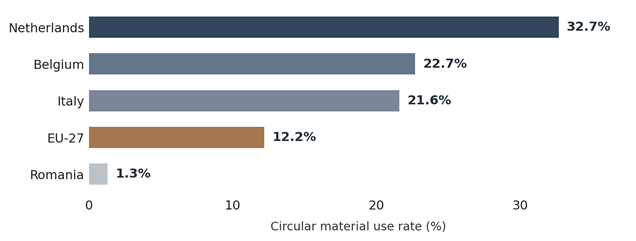
Figure 1. Circular material use rate in selected EU countries, 2024 [8]
The Netherlands reached 32.7% in 2024, compared with 12.2% for the EU and 1.3% for Romania. These differences describe the share of recovered materials in national material use; they do not measure the performance of individual companies or establish a causal relationship between a specific business model and an economy-wide outcome. Enterprise-level assessment needs a different set of indicators. Alongside operating margin and payback period, relevant measures include the proportion of inputs recovered, product lifetime, return logistics cost, utilization of retained assets and life-cycle emissions. Such measures should be reported together to reveal whether resource savings translate into commercially viable outcomes rather than a transfer of costs to suppliers or consumers.
Organizational and employment implications
Circular business models also redistribute work across production, logistics and after-sales services. Recycling and repair can create employment, while declining demand for primary resource extraction may displace workers in traditional industries. Retraining and the development of technical and digital skills are therefore important for adjusting to the shift [9]. A 2025 global assessment covering 177 countries estimates that 121-142 million people work in activities associated with the circular economy, illustrating the breadth of this labour market rather than the number of newly created jobs [10].
The distinction is important when assessing cross-border effects. A 2026 study estimates that exports of circular-economy goods support 5.96 million jobs worldwide, of which 73% are indirect; it also reports that 58% of these jobs are informal [11]. These figures concern employment embodied in circular trade, not all circular-economy employment. They point to workforce formalization, skill development and supplier standards as additional conditions for a socially sustainable transition. For SMEs, cooperation with specialized service providers and industrial partners can reduce the need to establish every circular capability internally. Recent empirical research indicates that industrial symbiosis networks and intermediary organizations may serve as alternative routes to the adoption of circular practices [12]. The organizational configuration should therefore be selected in conjunction with material flows and revenue arrangements, rather than treated as a separate sustainability initiative.
Conclusion
The transition to a circular economy changes enterprise business models when the retention of product and material value becomes part of the commercial offer, operating system and revenue structure. Product life extension, access-based services and material recovery create different opportunities and cost exposures; none guarantees improved financial or environmental performance without functioning return flows and viable customer arrangements. The evidence reviewed indicates that business model assessment should combine value capture, operating costs, material circulation and employment quality. Data limitations remain significant because national circularity statistics and global employment estimates cannot substitute for longitudinal enterprise-level evidence. Further research would benefit from comparisons of circular and linear models under consistent product, market and accounting boundaries.
References
- Eurostat. Over 12% of materials in the EU come from recycling // Eurostat News. 2025. 19 November. URL: https://ec.europa.eu/eurostat/web/products-eurostat-news/w/ddn-20251119-1.
- Woldeyes T.D., Muffatto M., Ferrati F. Emerging Business Model Archetypes in the Circular Economy: A Systematic Literature Review // Sustainable Development. 2025. Vol. 33. № 3. P. 4428-4456. DOI: 10.1002/sd.3348.
- Abdullina L. Mechanisms of adaptation of small and medium enterprises to the circular economy: international practices // Znanstvena misel journal. 2024. № 96. P. 20-23.
- Islam M.T., Khan M.I., Ali A. Circular business models: A state-of-the-art systematic literature review and future opportunities // Sustainable Futures. 2025. Vol. 10. P. 101097. DOI: 10.1016/j.sftr.2025.101097.
- Rinaldini M. Circular economy as a tool for reducing environmental impact in industrial production // Cold Science. 2025. № 24. P. 29-36.
- Frishammar J., Parida V., Panda D., Kaipainen J. On the Right Path to Circularity or Running Around in Circles? A Fresh Perspective on Circular Business Model Barriers // Business Strategy and the Environment. 2025. Vol. 34. № 4. P. 4958-4979. DOI: 10.1002/bse.4225.
- Ndoka E., Alimehmeti G., Shulla K., Voigt B.-F. Transitioning to circular business models in developing countries: A systematic literature review of barriers, enablers, and future directions // Discover Sustainability. 2025. Vol. 6. № 1. P. 605. DOI: 10.1007/s43621-025-01339-x.
- European Environment Agency. Circular material use rate by EU country (2010 and 2024) // EEA Data Indicator. URL: https://www.eea.europa.eu/en/analysis/indicators/circular-material-use-rate-in-europe/circular-material-use-rate-by.
- Abdullina L. Impact of the circular economy on the labor market in developing countries // International Independent Scientific Journal. 2024. № 67. P. 10-14.
- International Labour Organization, Circle Economy, World Bank Group, UN Partnership for Action on Green Economy. Employment in the circular economy: Leveraging circularity to create decent work. 2025. URL: https://www.ilo.org/publications/employment-circular-economy-leveraging-circularity-create-decent-work.
- Romero C.A., Michelena G.N., Ramos M.P., Ernst C., Pacin L. Circular economy, trade and employment. Geneva: International Labour Organization, 2026. 37 p. DOI: 10.54394/VSAU1377.
- Rosa B.O., Paula F.O. Substitutes or complements? How industrial symbiosis and intermediaries relate to the adoption of circular economy practices in SMEs // Journal of Cleaner Production. 2026. Vol. 556. P. 148189. DOI: 10.1016/j.jclepro.2026.148189.
- Koide R., Murakami S., Yamamoto H., Nansai K., Quist J., Chappin E. Prospective life cycle and circularity assessment of circular business models using an empirically grounded agent-based model // Journal of Industrial Ecology. 2025. Vol. 29. № 5. P. 1897-1911. DOI: 10.1111/jiec.70090.
Все статьи автора «author98211»
© Если вы обнаружили нарушение авторских или смежных прав, пожалуйста, незамедлительно сообщите нам об этом по электронной почте.