МОРСКАЯ ТОРГОВЛЯ И ГЕНЕЗИС КАПИТАЛИСТИЧЕСКОЙ МИР-СИСТЕМЫ В XVII-XIX ВВ.
Финансовый университет при Правительстве Российской Федерации
студентка 1 курса Факультета социальных наук и массовых коммуникаций
Ключевые слова: институты, капитализм, колонии, мир-система, торговля
MARITIME TRADE AND THE GENESIS OF THE CAPITALIST WORLD-SYSTEM IN THE XVII-XIX CENTURIES
Financial University under the Government of the Russian Federation
first-year student of the Faculty of Social Sciences and Mass Communications
Abstract
Nowadays, countries exchange products on a daily basis using different ways of shipping: air, land, sea and rail. However, the world leader in the volume of all international cargo is still the ocean freight. It accounts for over 80% of world trade volume, becoming the main support of the modern world economy. People have been using water bodies to trade and travel since the beginning of time. In this work an analysis of the role of maritime trade in the historical roots of the modern global economic system will be given. Our hypothesis is that modern processes of the global economy such as the international division of labour, structural inequality between «core», «semi-periphery» and «periphery» countries come from the era when maritime trade became the foundation of the world economy. Thus the article will also show additional factors of systemic accumulation of capital (development of financial systems and stimulation of the production sector) took place in the XVII–XIX centuries.
Рубрика: 08.00.00 ЭКОНОМИЧЕСКИЕ НАУКИ
Библиографическая ссылка на статью:
Морозова С.М. Морская торговля и генезис капиталистической мир-системы в XVII-XIX вв. // Современные научные исследования и инновации. 2026. № 1 [Электронный ресурс]. URL: https://web.snauka.ru/issues/2026/01/104144 (дата обращения: 20.10.2026).
Научный руководитель – Иванов Андрей Александрович, доктор исторических наук, доцент кафедры гуманитарных наук, Финансовый университет при Правительстве Российской Федерации
The XVII – XIX centuries became a turning point in the development of most countries in the world due to the blossoming of ocean freight, which formed not just mechanisms of capital accumulation but also how world economic relationships look now in general. In this era the formation of the capitalist world-economy was completed, in which maritime trade had the main role as an instrument of resource redistribution. But from one point, maritime commerce boosted European economic growth and technological progress, becoming the foundation of the Industrial Revolution, from another point of view, this progress was attained through exploitation of less developed countries. The transatlantic slave trade and colonial plunder deepened existing inequality and affected such regions as Africa, Asia, South and North Americas destructively [1, с. 48-97].
G. Arrighi in his theory of systemic cycles of capital accumulation claimed that global capitalism develops through a series of cycles in which a leading country relies on innovations in global trade routes, flows of finance, systems of property protection, and control over all of these factors [2, pp. 28-85]. In theory every cycle had two stages: a material expansion, characterised by trade and production growth and financial expansion, in which credit and financial instruments dominated. A cycle usually looks like economic and political leadership of one country, which is called the Hegemon, and shifts to another country when the phases are completed. Every cycle lasted approximately for 150-200 years. G. Arrighi highlights the «Dutch» systemic cycle of accumulation (XVII century) and the «British» systemic cycle of accumulation (XVIII–XX centuries). Thus, the theory gives the opportunity to analyse ocean freight not only as a way to trade but also as one of the main factors in the transition of leadership from one country to another. It was maritime trade that contributed to the growth of colonial empires and the accumulation of resources.
It is well known that by the end XV century, feudal economy reached its climax; stagnation started bringing along malnutrition and decline. During this period the landholdings started losing the main role in economics. Urban expansion, changes in the forms and methods of monetary circulation, the widening of goods production created the preconditions for a new economic policy (mercantilism), that was based on accumulation of capital as the main economic goal. Technological and geographical preconditions were also essential in this case. «The improvement of ships in the XV century, combined with direct sailing armament, as well as improved navigation techniques… allowed Spanish and Portuguese caravels to… cross oceans and make the Great Geographical Discoveries» [3, с. 4]. So, this Great Geographical Discoveries) opened the opportunity for maritime trade and appearance of global economic system, in which the main role was given to ocean freight. The development of naval technologies had a special role in this process as far as control over the ocean became a decisive factor in gaining national power. Powerful military fleets allowed European countries to not only to protect new trade routes and access to the resources of the colonies, but also deny this access to others. Thus, the combination of merchant marines and military fleets created the opportunity to establish trade relations and moreover to protect it, thereby, creating conditions for stable capital accumulation.
All of the above-mentioned transformations led to the formation of mercantilism which can be characterized by a number of components: understanding exclusively monetary capital as wealth; protectionism; retention of precious metals within the country (money was issued only in the form of metal coins made of precious metals) [4, с. 43]. All these factors were well suited to the goals of European countries at the time in terms of competition for colonial resources and control over maritime trade routes. Thus, mercantilism became an integrated economic strategy that combined technology, finance and the state into a single chain so that this system would work for the growth of national wealth. The fleet controlled the trade routes and brought gold to the country, enriching the state, which used part of the resources received to strengthen the navy, the merchant fleet and the army.
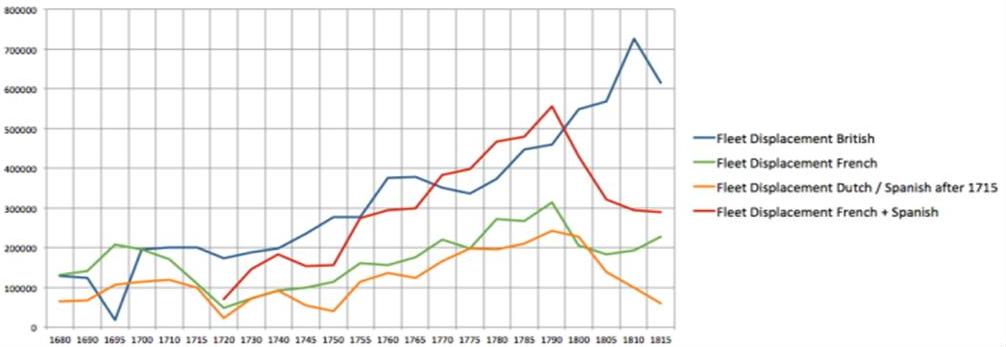
It is also important to mention the creation of economic institutions such as joint-stock companies, correspondent banks, stock exchanges and marine insurance systems as another component that played a role in the systematic accumulation of capital and transformation of maritime trade into a mechanism for capital accumulation. Joint stock companies became the key innovation of the XVII century, and even now they are often considered to be the highest form of business associations. The earliest joint-stock companies were the Dutch East India Company, founded in 1602, and the British East India Company, founded in 1600 under the name of the «The Governor and Company of Merchants of London trading with the East Indies». The companies allowed the investors to combine capital and share the risk of long-distance maritime trade as well as the profit. Moreover, the creation of the Amsterdam Stock Exchange helped capital to circulate flawlessly. Thus, shares of maritime trading companies could be bought and sold. Marine insurance reduced the risks that accompanied maritime trade. «However, credit was crucial also for the development of maritime trade: merchants, ship-owners and captains were often forced to borrow money to finance their activities or share risks. Over time, the flourishing of maritime trade led to the diffusion of several financial and legal instruments, such as commenda contracts, sea loans, bottomry, marine insurance and, of course, General Average, able to share risks or transfer risks on third parties» [5, p. pp. 335-359]. All of these innovations made maritime trading more reliable and safer which boosted its improvement and allowed it to become the main mechanism of capital accumulation. The statistics of displacement tonnage of European fleets in XVII – XVIII centuries confirm this statement (Table 1).
Table 1. Displacement Tonnage of European Fleets in XVII–XVIII centuries [6, p. 46].
The innovations created a legal financial foundation that gave an impulse to the development of maritime trade into a continuous process of investment and profit making. Thus, maritime trade and innovations in tandem contributed to fundamental change in the process of capital accumulation.
As a result, by the end of the XVII century, a group of preconditions: economic, technological and institutional had developed. They gave the maritime trade routes the impulse to become a leading factor in the systematic accumulation of capital. After mercantilism gained strength as a policy, and Great Geographical Discoveries provided new directions for trade and getting resources, the main routes were Atlantic, Pacific and Indian. They formed a network for movement of goods, capital and labor, which ensured the accumulation of wealth by European countries. The Atlantic Ocean became the center of trading system – it connected Europe, Africa and both of the Americas. At first, slaves were exported from the Cape Verde Islands and brought to the New World to work in the mines of Cuba. Then, in the XVII century, manufactured goods such as textiles, sugar, metals, weapons and alcohol were transported from Europe via the Atlantic route to Africa, where they were exchanged for slaves, who were then transported to America to work on plantations (sugar cane, tobacco, coffee, cotton). After that, the products obtained from the plantations were transported back to Europe via already mentioned transatlantic route. Europe earned huge profit from the sale of goods produced by slaves in America. The peak of the slave trade was in the XVI –XIX centuries, that also provides an understanding of the number of voyages and incoming capital. Thus, the transatlantic route made it possible for double capital accumulation to occur. First, because capital was accumulated through slave labor and cheap resources of the colonies, and then through the sale of European manufactured goods to foreign markets, as well as to the same colonies. So, the slave trade, which was made possible by the development of maritime trade, played a crucial role in the systematic accumulation of capital.
The Indian trade route also played a huge role in capital accumulation. By the XVI – XVII centuries, India and its ports were one of the most important parts of the exchange between Europe, Asia and Africa. «The mid to late seventeenth century saw a boom in Indian Ocean trade, marked by the emergence of several important entrepôts that dominated commerce in their own sub-regions, including Surat in Gujarat, and Madras, Porto Novo, and San Thome on the Coromandel coast. In these centers, groups of Hindu, Muslim, and Christian Armenian merchants expanded their trading networks to the shores of the Persian Gulf, the Red Sea, and the western edge of the Bay of Bengal. These traders were also joined by private European merchants who had become a respectable force in the region’s systems of exchange by the last quarter of that century» [7, p. 85]. Thus, it can be concluded that maritime trade through India did not occur periodically, but systematically, creating a stable system of capital accumulation, which was also growing. Not only goods were concentrated in Indian ports, but also capital and investments. Textiles, spices, and metals were exported through the Indian Route, while capital (silver) was imported. That is, it also became a way for the movement of precious metals and credit transactions, which strengthened financial institutions. As in the previous case, the Indian trade route gave capital the opportunity to move not only within countries, but also abroad. It also created conditions for the constant circulation of capital, as merchants and companies invested in expeditions, insurance and trade, making profits and reinvesting them in new expeditions, insurance and trading options. This created and expanded the system of capital accumulation.
The Pacific Sea Route connected Asia (China, Japan and Philippines), the Spanish colonies in America and Europe. It became the first permanent trade route between America and Asia, which made it an important part of global trade in the XVII – XIX centuries. «The development of direct trade between Asia and Spanish America, based on the shipment of large quantities of silver specie for Asian commodities and manufactures – primarily textiles – heralded the dawn of a truly global system of commerce» [8, p. 394]. That is, trade was constant, which again helped to redistribute and accumulate capital. It can also be concluded that silver from the Spanish colonies in America and textiles from Asia were the main commodities transported via the Pacific route. An average of 2 to 4 million pesos were transported through the Manila Galleon (approx. 50-100 tons of silver) every year. From 1501 to 1810, Spanish America is estimated to have produced around 80% of the world’s monetary stock. The the main sources of funding for the Pacific route were the capital market of Manila and correspondencias, as they offered working capital on favorable terms to takers in a rationed commerce that kept profit margins artificially high and reduced market volatility: «In the absence of a unified institutional structure to organize intercontinental financial exchanges via Manila, correspondencias evolved to fill this vacuum and provided a contractual framework allowing networks of merchants to mobilize vast quantities of traded silver across the Pacific and maritime Asia. Correspondencias were a securitized partnership where fixed returns (the premia) were calculated and agreed upon as a percentage of the initial investment based on the estimated profit margins on a given route» [8, p. 409].
As in previous cases of the Pacific and Indian routes, the financial institution supported maritime trade and made investments in it more insured and stable. Also, by the middle of the XVII century, one of the important parts of the capitalist economy, trade-cycle dynamics, had been formed in Asia, in which the Pacific Trade Route was actively involved. To summarize, the Pacific Trade Route consistently served as a channel for capital accumulation, redistribution, and reproduction in the XVII – XIX centuries.
Speaking about the global consequences, it is necessary to mention the contribution that in the case of Netherlands and England ocean control provided additional opportunities to strengthen their global influence. They concentrated their capital in East India Companies and marine insurance systems, which allowed them to become the main leaders of capital accumulation. At the same time Portugal is a good example of how maritime trade does not guarantee sustainable development into a «core» country – it became a «semi-periphery» country because, despite the large import of precious metals, it was not able to strengthen its economy with other processes in order to ensure stable development. For African countries, the development of maritime trade, on the contrary, became a path to the «periphery» status and crisis. They were drawn into maritime trade against their will to supply resources and labor without receiving reciprocal investments. The slave trade and the extraction of African resources were an integral part of the accumulation of European capital. Africa’s integration into the global economy took place under conditions that led to economic backwardness. In conclusion, maritime trade became one of the key factors in the systematic accumulation of capital in the XVII – XIX centuries as far as it provided ways for the movement and renewal of capital, new methods of enrichment and industrial development. At the same time, the development of maritime trade led to a crisis in less developed countries and increased global inequality.
References
- Вильямс Э. Капитализм и рабство. М.: Издательство иностранной литературы, 1950. 215 с.
- Arrighi G. The Long Twentieth Century. London: Verso, 2010. 432 p.
- Глебов А.М. История Мореплавания: от челна до линейного корабля. Горно-Алтайск: ГАГУ, 1999. 89 с.
- Рыжов И.В. Исторические условия возникновения и сущность меркантилизма. // Журнал прикладных исследований. 2022. Т. 1. №5. С. 42-45. DOI: 10.47576/2712-7516_2022_5_1_42
- Zanini A. General Average and Risk Management in Medieval and Early Modern Maritime Business. Cham: Palgrave Macmillan, 2023. 499 p. DOI: 10.1007/978-3-031-04118-1
- Halevy E. England in 1815. Vol. 1. London: Ernest Benn Limited, 1964. 655 p.
- Holroyd R. The shift from indirect to direct trade between China and South Asia, 1684–1740 // Journal of Global History. 2021. Vol. 16. №1. P. 85-100. DOI: 10.1017/S1740022820000157
- Rivas Moreno J.J., Ruiz-Stovel G. The Manila correspondencia and the institutional underpinnings of the trans-Pacific silver trade in the long eighteenth century. // Revista de Historica Economica - Journal of Iberian and Latin American Economic History. 2025. Vol. 43. №3. P. 390-412. DOI: 10.1017/S0212610925100803
© Если вы обнаружили нарушение авторских или смежных прав, пожалуйста, незамедлительно сообщите нам об этом по электронной почте.