СНИЖЕНИЕ ЗАТРАТ НА ИНФРАСТРУКТУРУ В ФИНТЕХ-ИНДУСТРИИ: СТРАТЕГИИ ИНТЕЛЛЕКТУАЛЬНОГО МАСШТАБИРОВАНИЯ
Национальный исследовательский университет «Высшая школа экономики»
бакалавр
REDUCING INFRASTRUCTURE COSTS IN FINTECH: STRATEGIES OF INTELLIGENT SCALING
National research university higher school of economics
bachelor's degree
Abstract
The article examines the problem of increasing infrastructure costs in fintech platforms operating in highly dynamic and transaction-intensive environments. It analyzes architectural and operational factors that form the cost structure of cloud-native fintech systems and emphasizes the limitations of traditional reactive scaling approaches. The study focuses on intelligent scaling as a cost optimization paradigm that integrates workload-aware service classification, predictive and scheduled provisioning, right-sizing, selective use of transient resources, and cost-aware autoscaling policies. It is shown that infrastructure expenditure is largely determined by design-time architectural decisions and the degree of automation in runtime resource management. The paper substantiates that intelligent scaling enables systematic alignment between resource consumption, performance requirements, and economic constraints. The results provide a conceptual basis for developing scalable and cost-efficient fintech platforms capable of sustaining long-term growth.
Keywords: autoscaling, cloud-native architecture, cost optimization, fintech infrastructure, intelligent scaling, microservices, resource management
Рубрика: 05.00.00 ТЕХНИЧЕСКИЕ НАУКИ
Библиографическая ссылка на статью:
Полянский А.В. Снижение затрат на инфраструктуру в финтех-индустрии: стратегии интеллектуального масштабирования // Современные научные исследования и инновации. 2026. № 2 [Электронный ресурс]. URL: https://web.snauka.ru/issues/2026/02/104193 (дата обращения: 21.09.2026).
Introduction
The rapid digitalization of financial services has resulted in increasingly complex and resource-intensive fintech infrastructures based on cloud platforms, microservice architectures, container orchestration, and data-driven processing pipelines, which, while enabling scalability and high availability, simultaneously generate substantial and continuously growing operational costs. In highly competitive fintech markets, infrastructure expenditure becomes not only a technical concern but also a strategic constraint for sustainable growth, directly affecting pricing models, profitability, and the ability to scale services predictably. This situation requires a transition from ad hoc cost-cutting measures to systematic, intelligent scaling approaches that integrate architectural design principles, automated resource management, and economically grounded optimization mechanisms. The aim of this study is to analyze strategies of intelligent scaling for reducing infrastructure costs in fintech systems and to assess their architectural and operational implications for achieving cost-efficient, reliable, and scalable digital financial platforms.
Infrastructure cost drivers in modern fintech platforms
Modern fintech platforms operate in environments characterized by high transaction intensity, strict latency requirements, and continuous functional expansion. These conditions lead to the formation of multi-layer cloud-native architectures that combine microservices, container orchestration, managed data stores, event-streaming systems, and observability tooling. Each architectural layer introduces its own consumption profile and pricing logic, resulting in a heterogeneous and interdependent cost structure [1].
A primary driver of infrastructure costs is systematic overprovisioning aimed at guaranteeing peak-load performance and fault tolerance. While this practice reduces the probability of service degradation, it produces long-term resource underutilization during normal operating periods. In addition, fine-grained service decomposition increases the number of deployed components, each requiring baseline compute, memory, and storage resources, which cumulatively generate substantial fixed costs.
Another significant contributor is the extensive use of managed cloud services. Databases, message brokers, caching layers, and machine learning platforms simplify operations but rely on consumption-based pricing models that are highly sensitive to request rates, data volumes, and network traffic [2]. In the absence of continuous monitoring and attribution, cost growth becomes difficult to predict and control.
The combined effect of these factors forms a layered cost landscape in which architectural decisions directly influence financial outcomes. This relationship between architecture and expenditure is schematically represented in figure 1.
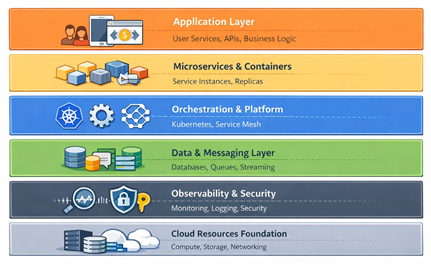
Figure 1. Layered structure of infrastructure cost drivers in modern fintech platforms
Figure illustrates the multi-layer structure of infrastructure cost drivers in a typical fintech platform, emphasizing their cumulative and interconnected nature. Infrastructure costs in fintech systems emerge from the cumulative interaction of multiple architectural layers rather than from isolated components. Consequently, effective cost reduction requires integrated, architecture-aware scaling strategies that address resource consumption across all layers simultaneously, forming the foundation for intelligent scaling approaches discussed in subsequent sections [3].
Intelligent scaling as a cost optimization paradigm
Intelligent scaling in fintech infrastructures represents a shift from reactive resource expansion toward proactive, workload-aware, and economically informed resource management. Unlike traditional autoscaling, which primarily responds to instantaneous utilization metrics, intelligent scaling integrates historical workload patterns, service criticality, and cost sensitivity into scaling decisions [4]. This approach enables platforms to differentiate between latency-critical transaction services, background analytical workloads, and auxiliary components, applying distinct scaling policies to each category. A central element of intelligent scaling is the coupling of architectural modularity with adaptive orchestration. Microservices that expose well-defined interfaces and exhibit limited coupling can be scaled independently, allowing resource allocation to be aligned more precisely with functional demand [5]. At the same time, predictive mechanisms based on time-series analysis and workload forecasting enable capacity to be provisioned ahead of expected peaks, reducing the need for permanent overprovisioning. From an economic perspective, intelligent scaling introduces cost-awareness into runtime control loops. Scaling policies incorporate not only performance thresholds but also budget constraints and unit cost indicators, such as cost per transaction or cost per active user. This allows infrastructure behavior to be evaluated in terms of business value rather than purely technical efficiency [6, 7].
The conceptual structure of intelligent scaling as a closed-loop process linking workload signals, architectural layers, and cost-aware control mechanisms is illustrated in figure 2.
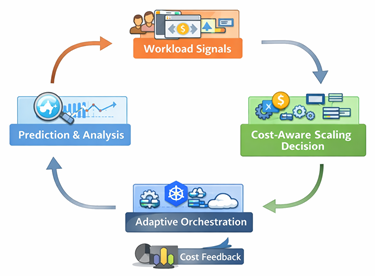
Figure 2. Intelligent scaling as a closed-loop cost optimization process in fintech platforms
The figure demonstrates that intelligent scaling functions as a continuous feedback-driven control cycle in which workload signals, predictive analysis, cost-aware decision-making, and adaptive orchestration are tightly integrated. This closed-loop structure enables fintech platforms to dynamically balance performance and reliability requirements with economic constraints, forming a systematic foundation for sustainable infrastructure cost reduction.
Core strategies of intelligent scaling for cost reduction
The practical implementation of intelligent scaling in fintech platforms relies on a set of complementary strategies that jointly address architectural design, runtime resource management, and economic control. These strategies are not mutually exclusive and are most effective when applied in combination, forming an integrated framework for cost-aware scalability [8].
-
Workload-aware service classification.
Fintech workloads can be systematically categorized into latency-critical transactional services, near-real-time analytical services, and background or batch-oriented processes. Assigning differentiated scaling policies to each class allows resources to be allocated in proportion to business criticality, preventing uniform overprovisioning across heterogeneous workloads.
-
Predictive and scheduled scaling.
Historical usage data and recurrent traffic patterns enable the anticipation of demand peaks and troughs. By provisioning capacity ahead of expected load increases and releasing it during low-activity periods, platforms reduce reliance on permanently overdimensioned infrastructures.
-
Right sizing and vertical optimization.
Continuous analysis of CPU, memory, and I/O utilization supports the adjustment of instance types and container resource limits. This prevents systematic oversizing of services and improves overall resource density.
-
Selective use of spot and preemptible resources.
Non-critical and fault-tolerant workloads, such as batch analytics or model training, can be executed on lower-cost transient compute instances, yielding significant savings without compromising core transaction processing.
-
Cost-aware autoscaling policies.
Scaling decisions incorporate not only utilization thresholds but also unit cost metrics and budget constraints, enabling trade-offs between marginal performance gains and additional expenditure.
-
Architectural consolidation and service rationalization.
Periodic evaluation of service portfolios helps identify redundant or low-value components, reducing baseline resource consumption and operational complexity.
Together, these strategies establish a systematic approach in which scaling behavior is explicitly aligned with both technical requirements and economic objectives, reinforcing the role of intelligent scaling as a central mechanism of infrastructure cost optimization in fintech environments [9].
Conclusion
Reducing infrastructure costs in fintech platforms cannot be achieved solely through isolated optimization actions or short-term cost-cutting measures. The findings of this study indicate that cost efficiency is primarily a consequence of architectural discipline combined with intelligent, automation-driven scaling mechanisms. Infrastructure expenditure emerges as an inherent property of system design, service decomposition, and workload management practices, which underscores the strategic nature of cost control in digital financial platforms.
The analysis demonstrates that intelligent scaling provides a coherent framework for aligning resource consumption with real demand while preserving performance, reliability, and regulatory compliance. By integrating workload-aware classification, predictive provisioning, right-sizing, and cost-aware autoscaling into a closed-loop control process, fintech organizations can systematically reduce structural overprovisioning and improve utilization efficiency.
Overall, intelligent scaling should be viewed as a long-term organizational capability rather than a purely technical feature. Its successful adoption requires coordination between architecture, operations, and financial governance. Such an integrated approach enables fintech platforms to sustain growth, maintain competitive pricing, and achieve predictable cost behavior under increasing scale and complexity.
References
-
George J.G. Leveraging Enterprise Agile and Platform Modernization in the Fintech AI Revolution: A Path to Harmonized Data and Infrastructure // International Research Journal of Modernization in Engineering Technology and Science. 2024. Vol. 6. № 4. P. 88-94.
-
Kovalenko A. Intelligent scaling of distributed payment systems: approaches to reducing infrastructure costs in high-load economies // Economy and Business: Theory and Practice. 2025. Vol. 7(125). P. 74-79.
-
Kumar G. Architecting Scalable and Resilient Fintech Platforms with AI/ML Integration // Journal of Innovative Science and Research Technology. 2025. Vol. 10. № 4. P. 3073-3084.
-
Rudomyotova L.S., Cheberyak N.G. Financial technologies in corporate liquidity management: challenges and prospects // Professional Bulletin: Economics and Management. 2025. № 3/2025. P. 43-51.
-
Moro-Visconti R. Artificial Intelligence-Driven Digital Scalability and Growth Options // Artificial Intelligence Valuation: The Impact on Automation, BioTech, ChatBots, FinTech, B2B2C, and Other Industries. Cham: Springer Nature Switzerland. 2024. P. 131-204.
-
Kovalenko A. Automation of monitoring and self-recovery mechanisms in backend architecture of financial systems // German International Journal of Modern Science. 2025. № 103. P. 8-11.
-
Bhatnagar S. Cost optimization strategies in fintech using microservices and serverless architectures // Computing. 2025. Vol. 19. № 01.
-
Berezhnoy A. Analysis of the application of the Java-oriented stack (Spring Framework, PostgreSQL, Redis) for building fault-tolerant enterprise digital solutions // Universum: technical sciences: electronic scientific journal. 2025. № 11(140). P. 15-20.
-
Hassan A., Hassan M.A., Khan M.A. Multi-Cloud Strategies for Scalable and Secure Fintech Applications // Journal of Educational Research in Developing Areas. 2023. Vol. 4. № 1. P. 123-133.
Все статьи автора «author98211»
© Если вы обнаружили нарушение авторских или смежных прав, пожалуйста, незамедлительно сообщите нам об этом по электронной почте.